Is the Principle of Climate Equity Still Fit for Purpose?
Rethinking Common but Differentiated Responsibilities Thirty Years After Rio
One of the founding principles of international climate policy is the concept of Common but Differentiated Responsibilities (CBDR). Adopted at the Rio Earth Summit in 1992 as part of the United Nations Framework Convention on Climate Change (UNFCCC), it recognizes that while climate change is a shared global challenge, countries do not bear the same responsibility for causing it.
The rationale was compelling.
Industrialized nations had been emitting greenhouse gases since the Industrial Revolution, building their prosperity on fossil fuels for more than a century before most developing countries began their own industrialization. By 1992, the overwhelming share of cumulative greenhouse gas emissions originated from North America, Europe and other developed economies.
Consequently, the UNFCCC recognized two important realities.
First, developed countries had contributed disproportionately to the accumulation of greenhouse gases in the atmosphere.
Second, developing countries still had legitimate aspirations for economic development and poverty reduction. Asking them to limit their emissions in the same way as wealthy nations would have been inequitable.
The principle of differentiated responsibilities therefore represented both historical fairness and economic realism.
Thirty years later, however, an important question deserves to be asked.
The World of 2026 Is Not the World of 1992
Does the framework established in 1992 still adequately reflect today’s world?
When the UNFCCC was negotiated, China represented only a small fraction of the global economy.
India’s economy was still relatively modest.
Many emerging economies had not yet entered their periods of rapid industrialization.
Since then, global economic geography has changed dramatically.
China has become the world’s second-largest economy and the largest manufacturing nation.
India has become one of the fastest-growing major economies.
Hundreds of millions of people have escaped poverty across Asia.
This transformation represents one of humanity’s greatest economic achievements.
It has also profoundly altered the geography of greenhouse gas emissions.
The principle of climate equity cannot ignore these structural changes.
Historical Responsibility Is Not Static
Historical responsibility is often presented as though it were fixed forever.
In reality, it evolves continuously.
Every year, new greenhouse gas emissions become part of cumulative emissions.
Every year, the contribution of each country to global warming changes.
This distinction is important.
Historical responsibility should not be confused with past responsibility alone.
It is a dynamic concept.
The cumulative contribution of every country continues to evolve as long as greenhouse gases continue to be emitted.
This is precisely what recent research illustrates.
The figure below, based on cumulative emissions of carbon dioxide (CO₂), methane (CH₄) and nitrous oxide (N₂O), estimates the contribution of different regions to the increase in global mean surface temperature.
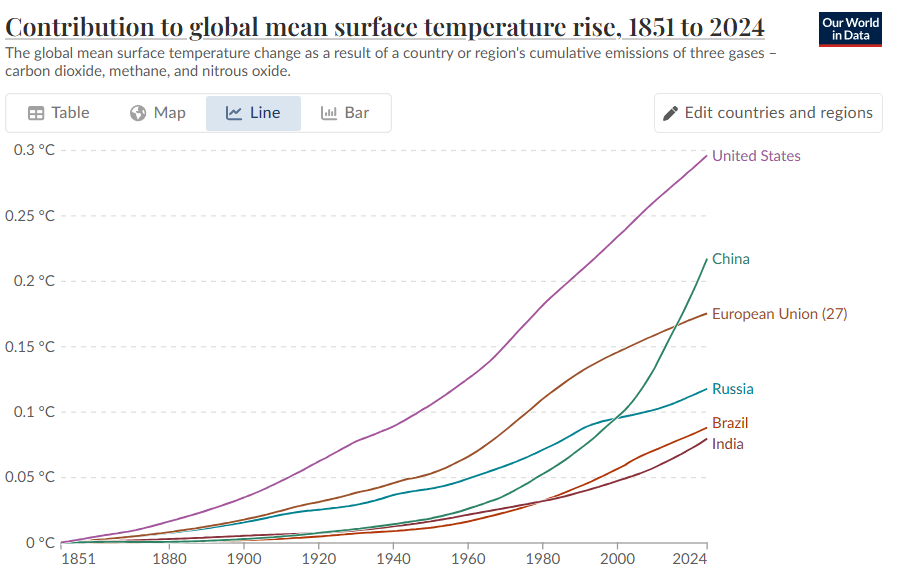
It shows that China’s cumulative contribution surpassed that of the European Union around 2016.
A simple extrapolation of recent trends suggests that China’s cumulative contribution could surpass that of the United States around the middle of this century.
This observation is not intended to assign blame.
Rather, it illustrates an important reality:
Climate responsibility evolves over time because cumulative emissions continue to evolve.
Climate Equity Should Evolve Alongside the Distribution of Emissions
Recognizing this evolution does not invalidate the principle of climate equity.
On the contrary.
Climate equity remains essential because countries continue to differ in their levels of development, financial resources, technological capabilities and vulnerability to climate change.
However, applying exactly the same framework designed in 1992 to the world of 2026 raises legitimate questions.
Today’s largest emitters possess very different economic capabilities than they did three decades ago.
Some countries that were once considered developing economies now rank among the world’s largest industrial and technological powers.
The climate debate should therefore gradually move beyond a binary distinction between « developed » and « developing » countries.
Instead, responsibility should increasingly reflect multiple dimensions simultaneously:
- historical cumulative emissions;
- current emissions;
- emissions per capita;
- economic capacity;
- technological capability;
- ability to finance mitigation and adaptation.
Climate equity should remain dynamic rather than static.
From Blame to Cooperation
The purpose of updating our understanding of climate responsibility is not to reduce the obligations of developed countries.
Far from it.
Europe, North America and other advanced economies must continue reducing emissions rapidly.
They must continue investing in clean technologies.
They must continue supporting climate finance and technological transfers.
However, focusing primarily on historical responsibility risks diverting attention from the larger objective.
The atmosphere responds to future emissions, not political narratives.
The ultimate goal is not to determine who should be blamed.
It is to determine how global emissions can decline as rapidly as possible.
Achieving this objective will require unprecedented cooperation among all major emitters.
No credible pathway to net zero exists without active participation from China, India, the United States, the European Union and every major emerging economy.
Climate change has become too large a challenge to be approached primarily through the lens of historical divisions established more than thirty years ago.
A Framework for the Twenty-First Century
The principle of Common but Differentiated Responsibilities was one of the great achievements of the Rio Earth Summit.
It recognized historical realities that could not be ignored.
But history did not stop in 1992.
Neither did emissions.
Nor did the global economy.
If climate responsibility evolves continuously, perhaps the framework through which we understand climate equity should evolve as well.
The objective should not be to abandon the principle of equity.
The objective should be to ensure that it continues to reflect the realities of the twenty-first century.
Only then can climate policy remain both scientifically credible and politically legitimate.

